
From the Organist & Choirmaster
This Sunday, the parish choir will sing at the Offertory Leonard White’s adaptation of a prayer associated with Saint Richard of Chichester.
‘O holy Jesus, most merciful redeemer, friend and brother, may I know thee more clearly, low thee more dearly, and follow thee more nearly, and follow thee more nearly. Amen’
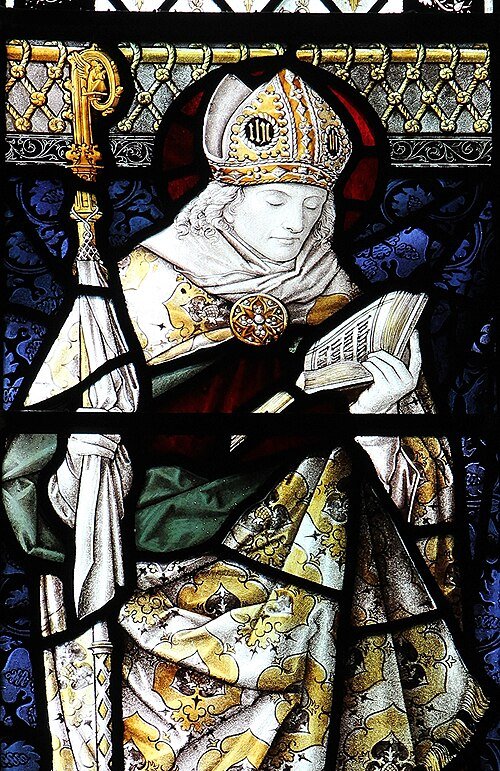
Saint Richard (1197-1243) is associated with Chichester as he was the bishop there from 1244 until his death. Saint Richard was born in the Buford area near the town of Wyche (modern Doritwich in Worcestershire) and was an orphan member of a gentry family. When his parents died, his elder brother was heir to the estates but was not old enough to inherit, so the lands became subset to feudal wardship. Upon his coming of age, his brother took possession of their lands, but was required to pay a medieval form of death duty that left the family so impoverished that Richard had to work for him on the family farm.
He was educated at the University of Oxford where he then went on to teach. From there he proceeded to Paris and then Bologna, where he distinguished himself by his proficiency in canon law. On returning to England in 1235 in his late thirties, Richard became Oxford’s chancellor. His tutor, Edmund of Abingdon, had become the Archbishop of Canterbury around this time. Richard shared the same views as Edmund, supporting clerical reform and supporting papal rights even against the king. In 1237, Edmund appointed Richard chancellor of the diocese of Canterbury. He joined Edmund at his exile, and was with him with the archbishop died in 1240. Richard then decided to become a priest, and studied for two years with the Dominicans at Orléans. Once again, returning to England, Richard became the parish priest at Charing and at Deal,, but soon was reappointed chancellor of Canterbury by the new archbishop Boniface of Savoy.
In 1244 Richard was elected as Bishop of Chincester. Henry III and part of the chapter refused to accept him for his views on papal rights, the king favoring the candidature of Robert Passelewe. Archbishop Boniface rested to confirm that latter, so both sides would appeal to the pope. The king confiscated the see’s properties and revenues, but Innocent IV confirmed Richard’s election and consecrated him bishop at Lyons in March 1245. Richard returned to Chichester, but the king still refused to restore the see’s properties for two years, and then did so only after being threatened with excommunication. Henry forbade anyone to house or feed Richard.
His shrine was located in Chichester Cathedral and was a long place of pilgrimage, and in 1262, just nine years after his death he was canonized into sainthood at Viterbo by Pope Urban IV. The shrine enjoyed a level of popularity approaching that accorded to Thomas Becket’s at Canterbury. The document ordering the destruction of the shrine was issued to Sir William Goring and William Ernie, receiving forty pounds for carrying out the commission on December 20, 1238.
It is said that Richard recited his prayer on his deathbed, surrounded by the clergy of his diocese and has even been adapted by Stephen Schwartz for his musical Godspell as “Day by Day.”