
Episcopal church supports chaplains, service members in time of war
By ENS Staff
Posted Mar 9, 2026
“Having endured many years of complex political, economic and social challenges, the people of Iran—numbering more than 92 million—now face the immediate threats of the current conflict, and a very uncertain future,” reads the statement. “The humanitarian risks and suffering will inevitably escalate the longer this conflict continues.”
The statement also expresses grave concern over reports indicating serious violations of international humanitarian law during the ongoing military operations.
“We insist that as a matter of moral and legal obligation all conflict participants must protect civilians from harm, and refrain from targeting civilian areas and infrastructure,” reads the statement. “Moreover, we fear that the conflict may result in a new period of prolonged violence and instability in the wider region.”
The statement further notes that the conflict is now impacting the lives and livelihoods of people, communities, and societies in the whole region. “Along with the rest of society in Iran and the wider region, churches and Christian communities face the dangers this war poses for their future,” reads the statement. “It must be emphasized that the joint Israeli and US attacks are clearly illegal under international law.”
The statement urges that Israel and the US must not be permitted to once again create a desolation and call it peace. “They must take responsibility for the consequences of their actions, including the consequences for the future of the people of Iran whose freedom they claim to promote,” reads the statement.
Emphasizing that as Christians we do not recognize any divine licence to kill, destroy, displace or occupy, the statement affirms that “war is incompatible with God’s very nature and will for humanity, and against our fundamental Christian principles.”
The statement laments the absence of morality and legality, the prevailing arrogance and ideologies of power, and the replacement of conscience with political utility. “W[Episcopal News Service] The Episcopal Church is supporting its military service members, including chaplains, as some of them who are stationed in the Middle East prepare to serve during wartime and others prepare to deploy to the region.
An undisclosed number of Episcopal chaplains are serving on military bases in the United States and worldwide. All of those serving in the Persian Gulf region have been accounted for, the Rt. Rev. Ann Ritonia, The Episcopal Church’s bishop suffragan for Armed Forces and Federal Ministries and a U.S. Marine Corps veteran, told Episcopal News Service. Part of her job overseeing military chaplains requires that she be in regular communication with them.
“I’m making sure they have all that they need and that they know they have the prayers and support of the church for the work that they do,” Ritonia said.
The United States and Israel launched a series of joint attacks on Iran on Feb. 28. Iran responded by launching attacks throughout the Middle East. The attacks have continued to escalate across the region.
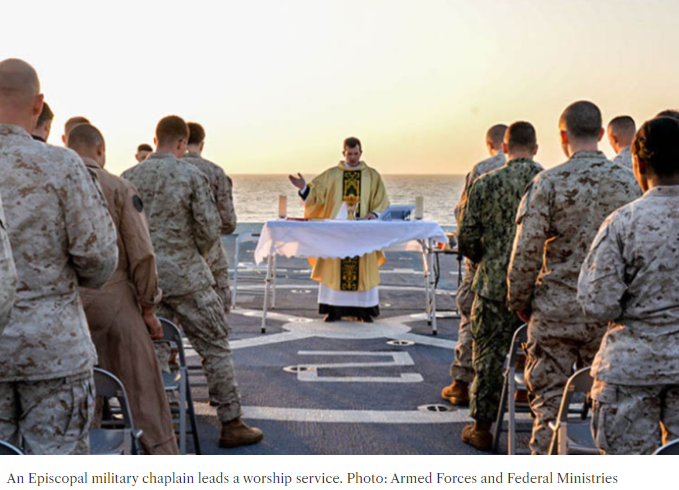
About 3,000 active-duty, reserve and National Guard chaplains of many faiths serve the U.S. military, according to the most recent military data available, from 2023. Chaplains offer service members and their families spiritual and moral support. They provide religious services, including rites and sacraments, and religious formation. They also provide counseling and help service members keep calm during operations such as “Operation Epic Fury.”
Military chaplains complete basic training and, like their fellow service members, sometimes deploy to active war zones, though their duties are noncombatant, meaning they’re unarmed and are not permitted to fight. And, just like their fellow active-duty service members, they must follow the Department of Defense’s code of ethics and remain nonpartisan while on duty, in uniform or acting in an official capacity. This means they cannot publicly comment on the war.
“Right now, [the chaplains] are continuing to do their work whether or not they agree with this incursion into Iran. They’re still faithfully taking care of their soldiers and their airmen and their Marines and their sailors, as they’ve been called to do,” Ritonia said. “Obviously, they’re concerned. They are worried about families. There’s a lot of fear, because there doesn’t seem to be an endgame in place.”
As of March 9, seven U.S. service members, 13 Israeli civilians, including two soldiers, and at least 1,230 Iranians have been killed since the armed conflict began, according to government reports.
Immediately following the initial attacks, Anglican and Episcopal leaders lamented the long-term effects they and Iran’s counterstrikes would have on civilians, including death and suffering. Archbishop Hosam Naoum, bishop of the Episcopal Diocese of Jerusalem and primate of the Anglican Province of Jerusalem and the Middle East, in a Feb. 28 letter called for prayers “to protect the innocent – the mothers, the children and the elderly – who are caught in the crossfire of ‘Operation Epic Fury’ and the subsequent ‘crushing responses.’” His province includes the Diocese of Iran, which has four churches.
Episcopal Church Presiding Bishop Sean Rowe also asked Episcopalians to pray for members of the Diocese of Iran and for all Iranians, in a Feb. 28 letter. “As Christians who follow a Prince of Peace, we mourn that … [these] attacks will surely mean further hardship for the most vulnerable Iranians and, as retaliation inevitably follows, suffering that will spread across the entire region,” he said.
On March 10 at 12 p.m. Eastern, Rowe and other faith leaders will lead a virtual interfaith prayer vigil for peace in the Middle East. Registration is open to everyone.
Outside the church, lawmakers and legal experts have questioned the legality of the U.S. strikes, which were launched without prior congressional approval. The Republican-led House and Senate last week both voted against limiting President Donald Trump’s ability to conduct further military operations in Iran.
Additional discourse began last week after the nonprofit Military Religious Freedom Foundation reported that it had received more than 200 complaints from service members alleging that commanders had been invoking far-right Christian nationalist rhetoric to justify going to war with Iran. One anonymous complaint from a noncommissioned officer claimed that their commander “urged us to tell our troops that this war was ‘all part of God’s divine plan’ and he specifically referenced numerous citations out of the Book of Revelation referring to Armageddon and the imminent return of Jesus Christ.”
Ritonia said she hasn’t heard any of these claims from Episcopal chaplains, but if the allegations are true, “it would be a violation of the oath that the secretary of defense and every military officer and enlisted person have taken, and they are not upholding the Constitution.”
“As Christians, we must never, ever seek out war. It’s against everything that Jesus Christ taught,” she said.
Armed Forces and Federal Ministries’ web page includes information about military chaplains and just war theory, a tradition of military ethics that establishes moral, legal and theological boundaries for engaging in armed conflict.
The Rev. Andrea Baker, a retired U.S. Army Episcopal chaplain who lives in Hawai’i, told ENS that she believes the claims are credible, “and it’s extremely concerning.”
“I already didn’t get a good night’s sleep when I went to bed [on Feb. 27 – Iran is 13.5 hours ahead of Hawai‘i] and looked at my phone and saw that the war had begun,” Baker said. “Then I started thinking that there are going to be people who would be happy about this because they believe we are hastening the second coming of Christ, and that is absurd.”
News of the latest armed conflict in the Middle East triggered Baker’s post-traumatic stress disorder stemming from her 2014 deployment in Afghanistan. She said she suddenly could hear helicopters whirring and sirens, reminding her of nonstop air raid sirens going off in Kandahar.
As part of her deployment, Baker had to stand and salute caskets carrying the remains of fallen U.S. service members.
“Immediately after reading the news about attacking Iran, I began to pray for the chaplains who are over there in the Middle East, and for all the military members and their families,” Baker said.
Baker and Ritonia also recommended “being attentive” to combat veterans living in their communities because news of the Middle East conflict “may stir up some challenging and potentially difficult feelings from their past experience.”
Many military chaplains, Ritonia noted, are stationed in military bases outside the Middle East, including the United States. Civilian Episcopalians who want to support chaplains based in their local dioceses can reach out and ask what they immediately need.
Another way to support chaplains, Ritonia said, is to call lawmakers and “exercise the right of free speech and religion.” In a similar vein, on Feb. 28 The Episcopal Church’s Office of Government Relations’ Episcopal Public Policy Network issued an action alert calling on Episcopalians to contact their members of Congress and tell them to “do all they can to stop escalating violence.”
Praying for safety, courage and comfort is also a way to support military chaplains, Ritonia and Baker said. They both recommended reading the prayers for the armed forces, for peace and for the human family in The Episcopal Church’s Book of Common Prayer, as well as Psalm 121 and Psalm 139.
“We don’t know how this conflict is going to escalate – a lot is still very much unknown,” Ritonia said. “But now and always, the chaplains are remaining faithful to Jesus Christ throughout this in caring for those on the margins.”