
Full & Equal gathering celebrates 50 years toward full inclusion, looks to future work
By Mary Frances Schjonberg
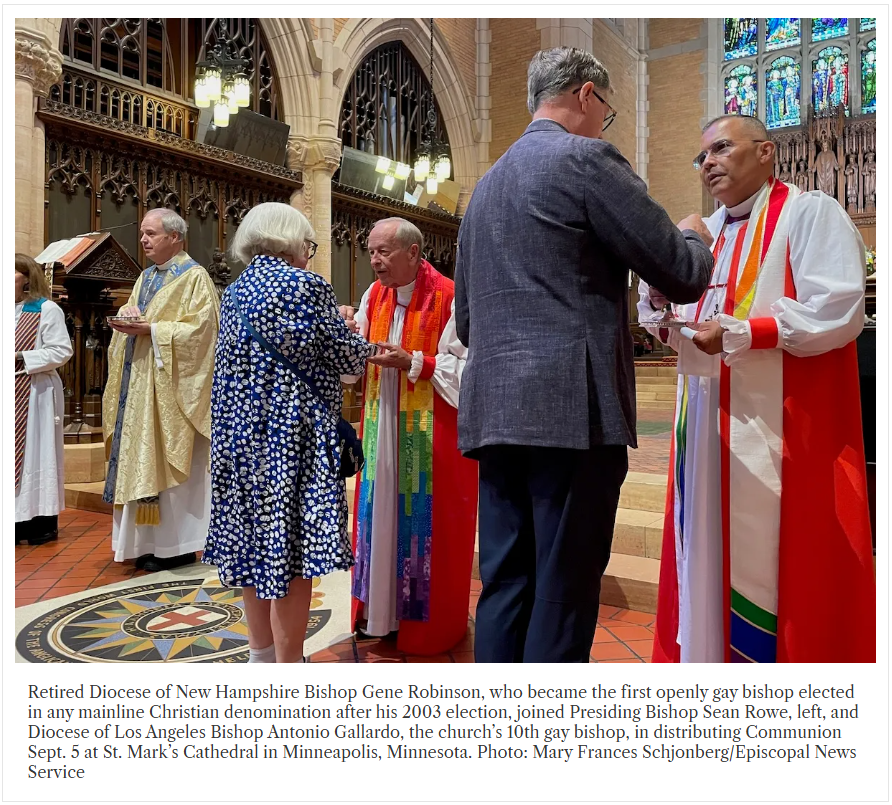
[Episcopal News Service – Minneapolis, Minnesota] A gathering to mark the half-century since General Convention declared that “homosexual persons are children of God who have a full and equal claim with all other persons upon the love, acceptance, and pastoral concern and care of the Church” was not a victory lap.
Instead, Full & Equal: 50 Years in Pursuit of a Promise was “another leg on the relay race as we tell the stories of the past, as we reflect on where we are in the present, and as we look ahead to God’s future,” said the Rev. Susan Russell, chair of General Convention’s Task Force on LGBTQ+ Inclusion, which organized the Sept. 3-5 gathering with the support of the presiding bishop’s staff.
The nearly 200-participant gathering was held at the Sheraton Minneapolis Downtown Convention Center. It fulfilled part of the task force’s mandate to conduct a churchwide audit of how The Episcopal Church has lived into its commitment made here in 1976. The task force is also charged with beginning a process of creating an archive of the history of the work for LGBTQ+ inclusion in The Episcopal Church. The goal, Russell told the attendees, is to learn from the stories and “make sure that we do not squander the inheritance we have.”
Moreover, Russell said, recording and telling the stories of the last 50 years goes beyond the church and into a wider cultural context.
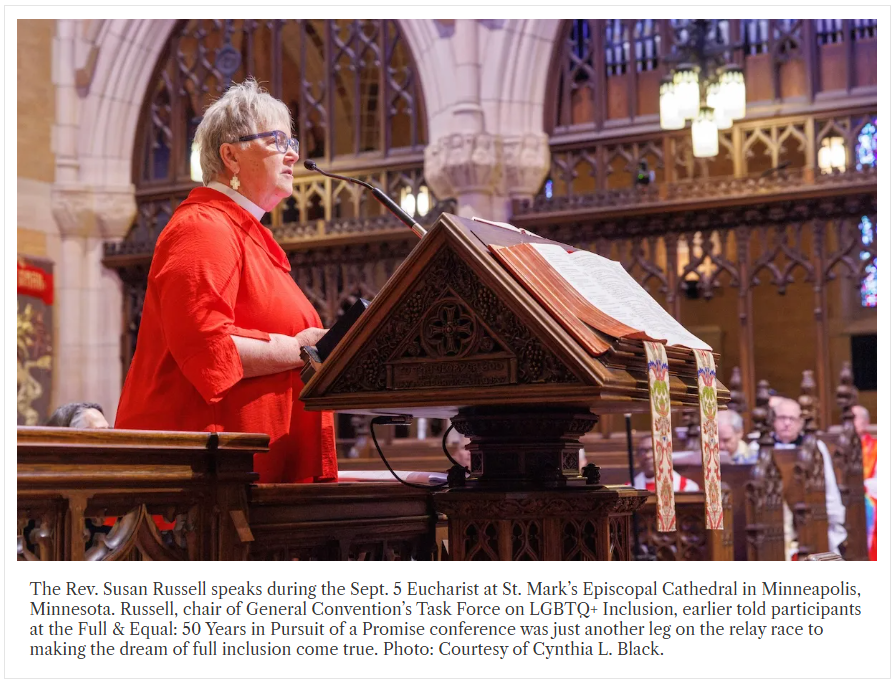
“We, as the church, have an opportunity to give an example to a culture right now where there are forces at work trying to push us back on everything,” she continued. “What we’ve learned about pushing back against the kind of religious fundamentalism in our church can serve us as we continue to push against the Christian nationalism in our nation, the fascism that is trying to turn us into an oligarchy rather than democracy.”
The gathering combined worship, education and storytelling to provide participants with tools and inspiration for future advocacy work and to preserve the stories of the last five decades.
The participants learned storytelling techniques used by storytellers on The Moth Radio Hour. Organizers structured the gathering around the storytelling idea, with lay and ordained speakers telling some of the stories of then, now and next.
The Rev. Cynthia Black acknowledged during the “Story of Then” session that the stories of then are often painful. “Obviously there are stories that aren’t about pain, but I think it’s important that we name the painful ones because they continue,” she said. “Part of the reason we’re here is to help make sure that the pain we have experienced is not something that continues, and that the young people today – or however old anybody is today – doesn’t have to live through what we lived through.”
Anne Brown told a “Story of Then” about Episcopalians advocating for marriage equality. In 1999, then-Diocese of Vermont Bishop Mary Adelia McLeod and other lay and ordained Episcopalians testified about their support of marriage equality during state legislative committee hearings, Brown said. A year later, the state created civil unions for same-sex couples rather than allow same-sex couples access to marriage. Diocesan leaders decided not to oppose the civil union law, but to say, “OK, let’s go with this,” Brown recalled. McLeod took the new law “as an OK excuse” for several Episcopalian couples to have liturgical rites acknowledge their unions, including her and the Rev. Lee Crawford.
However, there was no sanctioned rite for such a church service, so “we were all doing our own liturgies,” Brown said, adding that they did so in a way that did not get McLeod in trouble with the wider church. McLeod’s successor, Bishop Tom Ely, asked Brown to co-chair a committee to develop a diocesan liturgy “which sort of said that we were doing what we were doing within the bounds of our common life.” The liturgy that the committee created included a statement about the theology of such unions, “which was really important to show we were doing the theology,” Brown said.
Vermont Episcopalians began their work nine years before The Episcopal Church approved a provisional blessing rite for same-gender couples.
Presiding Bishop Sean Rowe, in wide-ranging comments during the “Story of Now” session, said there is still pain in the church and the world today.
“The way that trans people are being treated in this world, in this culture, in this country, it is one of the many things that keeps me up at night,” he said. “It’s contrary to the gospel. It’s a scandal to the heart of God.”
Rowe said, “The [church’s] old playbook for advocacy doesn’t work in this environment because it often puts people in danger.” Thus, he said, his office does not speak about its ongoing efforts to connect with and support people who minister to trans people. And, still, some of those efforts to aid such ministries and others, including assisting immigrants of all statuses, have prompted federal investigations against the church, he said.
Diocese of Michigan Bishop Bonnie Perry told the “Story of Next” session that “the world needs the church.”
“Our country needs The Episcopal Church, and the church needs us – compelling, faithful, lay, and ordained queer leaders; the church needs us. And some non-queer leaders of all types,” she said.
Wounds, pain and sadness still abound in the church and the world, Perry said. People need to keep addressing their previous suffering “so that we may be able to go into the fraught world wounded but embodying the hope of Jesus Christ, that we too might be heroes.”
“I think that’s what’s next – to be real about our pain, to do the work, and, oh my heavens, believe. Because the world needs us, and the world needs Jesus Christ.”
The gathering ended with Eucharist on Sept. 5 in a packed St. Mark’s Cathedral. Retired New Hampshire Bishop Gene Robinson told the congregation during his sermon that the Eucharist is “where we can come to remember the dream of full acceptance and inclusion, and, for just that moment, feel the joy of our eventual future.”
Robinson urged the congregation not to be discouraged. He recalled how, despite slow progress, The Episcopal Church risked “pain and schism for our dream” when it agreed to New Hampshire’s decision in 2003 to elect him the first openly gay bishop in any major Christian denomination. Lutherans, Presbyterians and Methodists watched, he recalled, “to see if it was literally going to kill us, and it might have. When it didn’t, they began to join us.”
“So, when you’re feeling down now, and you’re feeling discouraged, remember our church risked its life for us.”
Robinson said the journey is not over because the dream of 1976 has not yet come true. However, he said, “we know, don’t we, where this will end? This will end with the full inclusion of not only those of us who are queer and beloved in the eyes of God, but those who are also excluded for other reasons, some of whom we haven’t even yet noticed so that all of God’s children, even those for now who oppose us, will become beneficiaries of that dream we articulated 50 years ago.”
Echoing the day’s Gospel, where Jesus beckons Peter to walk to him on the water, Robinson said it was once again time to “get out of whatever boat you’re in and walk on the water. Do it for yourself. Do it for one another. Do it for the love of God.”
Robinson’s sermon is here.
Organizers of the Full & Equal gathering plan to release videos of many of the sessions, along with a documentary that premiered at the conference. The group hopes to develop a curriculum to accompany that documentary so that congregations and dioceses can use it for study and reflection.
– The Rev. Mary Frances Schjonberg is a freelance writer who formerly was a senior editor and reporter for Episcopal News Service.